
Table of Contents
- Understanding the Coyote Threat to Your Dog
- What Attracts Coyotes to Your Yard
- How to Keep Coyotes Out of Your Yard
- What to Do If You See a Coyote While Walking Your Dog
- Choosing a Coyote Vest for Small Dogs
- Step-by-Step: How to Protect Dogs from Coyotes During an Encounter
- After an Attack: Immediate Steps and Recovery
- Conclusion
- Frequently Asked Questions
Last Updated: October 18, 2026
Understanding the Coyote Threat to Your Dog
Coyotes now live in cities, suburbs, and rural areas across the country. That means a backyard potty break can turn into a close call fast. This guide from Raptor Shield explains how to protect dogs from coyotes with practical, layered steps.
Coyotes are adaptable predators. They lose their fear of people when food is easy to find. And a small dog left alone outdoors looks like prey.
The key idea is simple: coyote safety is a numbers game you win by stacking barriers. Fences, leashes, timing, and supervision all reduce risk. No single step does the whole job.
Why Small Dogs Are at Higher Risk
Size changes the math. A coyote that would ignore a Labrador may target a Chihuahua or a Yorkie without hesitation. Small dogs are closer to a coyote's natural prey in size and movement.
Age and temperament matter too. A slow senior dog or a bold puppy that runs toward danger carries more risk. So does any dog that freezes instead of coming when called.
Location plays a role as well. Homes near greenbelts, parks, golf courses, or open fields sit on coyote travel routes. Wildlife agencies such as your state's fish and wildlife department publish local guidance worth checking.
What Attracts Coyotes to Your Yard
Coyotes show up for three reasons: food, shelter, and easy access. Remove those and your yard stops looking like a destination.
Common draws include:
- Pet food and water bowls left outside overnight
- Bird feeders that spill seed and attract rodents, a coyote food source
- Fallen fruit from trees
- Trash cans without locking lids
- Dense brush or gaps under decks that make good dens
- Unattended small pets outdoors
A coyote that finds a meal returns. That is the trap most people fall into.
How to Keep Coyotes Out of Your Yard
Start with the perimeter. A secure fence is the single most reliable barrier between your dog and a coyote, but "secure" is not a feeling, it is a set of measurable specs. Most coyotes can clear a standard 4-foot fence and dig under a loose one. Build for both.
Fencing and Physical Barriers
Use these dimensions as your build sheet:
- Height: 6 feet minimum; 8 feet is better if you live near greenbelts, parks, or open fields where coyotes travel. A coyote can clear 5 feet from a standstill and higher with a running start.
- Buried barrier: Bury hardware cloth or welded wire 12 to 18 inches deep along the entire fence line, then bend the bottom 6 inches outward in an L-shape. This stops digging at the base and prevents a coyote from nosing under the mesh.
- Gap limits: Seal any opening wider than 4 inches, under sheds, decks, gates, and along the bottom of the fence. A coyote can squeeze through a gap you would not expect.
- Coyote rollers: These rotating PVC pipe sections sit on top of the fence on free-spinning brackets. A coyote cannot grip the spinning surface to pull itself over. Install them on the top rail and on any gate tops.
- Gate hardware: Use a self-latching, lockable gate. Coyotes are strong and can nose open a loose latch; a carabiner or padlock removes that option.
- Maintenance: Walk the fence line monthly. Coyotes dig, and a single new hole at the base undoes the whole barrier. Check rollers for seized bearings and re-bury any exposed mesh.
Inside the yard, a covered or enclosed play area gives small dogs a safe zone. A roofed kennel run blocks both ground predators and birds of prey.
Motion-activated lights and sprinklers add a startle effect. They help, but treat them as backup, not a substitute for a fence.
What to Do If You See a Coyote While Walking Your Dog
Stay calm, keep your dog close, and make yourself look big. That is the short answer. Here is how to protect dogs from coyotes on a walk.
First, shorten the leash. A 6-foot leash gives you control. Retractable leashes do not.
Then act large and loud:
- Stand tall and raise your arms
- Shout firmly and clap
- Throw a stick or object near the coyote, not at it
- Back away slowly while facing the animal
Never run. Running triggers a chase instinct. Never turn your back or crouch down.
Walk with an adult handler when possible. A second person can watch the surroundings and help manage the dog.
Hazing, meaning scaring a coyote away without harming it, is encouraged by many state wildlife agencies to keep coyotes wary of people.
Choosing a Coyote Vest for Small Dogs
A coyote vest for small dogs adds a physical layer between your pet's body and a predator's teeth or talons. It buys time. That time is often the difference between a scare and a tragedy.
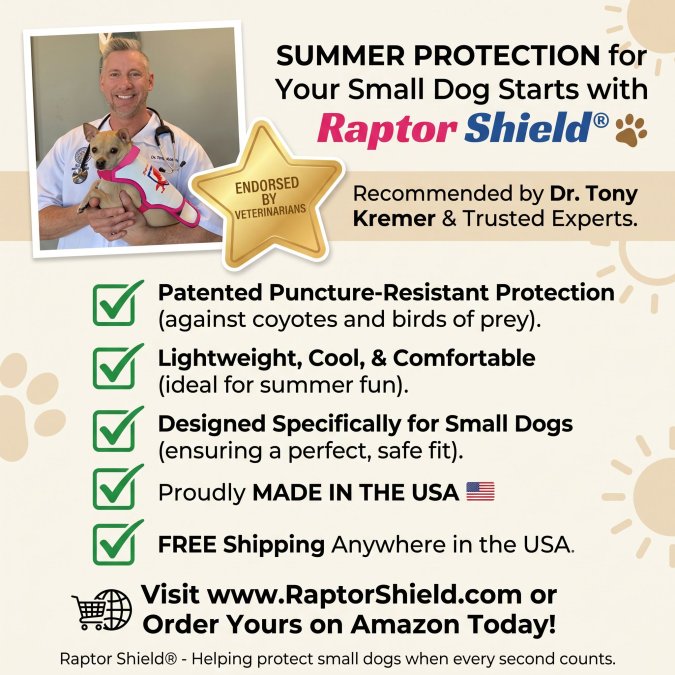
Raptor Shield builds patented, puncture-resistant vests and collars for exactly this purpose. The material is similar to what goes into bulletproof glass, and the design is talon-proof. It is lightweight, so dogs can still run and play.
Fit matters most. Our vests come in sizes based on weight and chest measurement:
| Product | Dog Weight | Chest | Price |
|---|---|---|---|
| Raptor Shield Vest - Medium | 7-11.5 lb | 13.5-17 in | $81.50 |
| Raptor Shield Vest - Large | 12-21 lb | 17.5-23 in | $81.50 |
| Raptor Collar - Small | Neck coverage | Adjustable | $21.50 |
| Raptor Collar - Medium | Neck coverage | Adjustable | $24.50 |
The vests are spike-free, so they are safe around other pets and children. Buy two or more and get $10 off.
One honest note: no vest can guarantee safety against a determined predator. Gear limits injury and adds escape time. It works best paired with supervision and a secure yard.
Step-by-Step: How to Protect Dogs from Coyotes During an Encounter
If a coyote approaches, follow these steps in order. Knowing them ahead of time is how to protect dogs from coyotes when seconds count. The sequence matters: you assess before you act, and you put your body between the dog and the animal before you make noise.
- Stop and assess. Freeze for one second and count. Note how many coyotes you see and where they are. A single coyote may be a scout; a pair or a group changes your exit plan. Look for cover, a car, a porch, a doorway, and pick your destination before you move.
- Get your dog close and behind you. Reel in the leash to 3 feet or less and step so your body is between your dog and the coyote. Do not yank the dog into the coyote's path. If you have a second dog, keep both on the same side of your body.
- Make yourself big. Raise your arms overhead and stand tall. Open a jacket wide if you are wearing one. The goal is to look larger than a coyote wants to test.
- Make noise. Shout in a low, firm voice, clap, blow a whistle, or sound an air horn. High-pitched screaming can sound like prey; aim for a command voice.
- Throw something near it. A stick or rock tossed toward the coyote, not at it, can startle it off without injuring it. Hazing that harms an animal is often illegal and can make it more aggressive.
- Back away slowly. Keep facing the coyote and move toward your chosen destination. Do not turn your back, do not crouch, and do not run. Running triggers a chase instinct.
- Get indoors or into a car. Once inside, check your dog head to tail before you do anything else. Run your hands through the fur against the grain to find punctures you cannot see.
- Report the sighting. Call local animal control or your state wildlife agency. A report helps track coyote activity and may warn neighbors with small pets.
If a coyote does make contact, do not chase it. Focus on getting your dog to safety and to a vet. A coyote that has made contact is more dangerous than one that is only approaching, and your priority shifts from deterrence to extraction.
After the encounter, watch your dog for the rest of the day. Shock can mask pain, and a dog that seems fine in the moment may stiffen or hide later. The next section covers what to do if contact actually happens.
After an Attack: Immediate Steps and Recovery
Act fast. A coyote bite carries real infection risk, and hidden injuries are common under thick fur.
- Call your vet or an emergency clinic right away. Tell them a coyote was involved.
- Check for puncture wounds, bleeding, and shock. Cover wounds with a clean cloth.
- Follow your vet's guidance on rabies and wound care. Rabies is a serious concern with any wild animal bite, and the CDC advises prompt medical attention.
- Report the incident to animal control so they can track coyote activity in your area.
- Watch for behavior changes in the days after, such as lethargy or loss of appetite.
Our customers tell us the worst part is the waiting. One owner shared that her dog wore a Raptor Shield vest during a coyote attack and came out of it safe and clean. That is the outcome we build for.
Conclusion
Coyotes are here to stay, and a single lapse in supervision is all it takes. Stack your defenses: secure fencing, leashed walks, smart timing, and gear that buys your dog time.
Raptor Shield makes patented, puncture-resistant vests and collars built for small dogs, with free shipping anywhere in the USA. Our gear is lightweight, spike-free, and made in the USA.
Don't wait for the close call. Protect your small dog with Raptor Shield today. Visit www.RaptorShield.com, order on Amazon, or buy now with our secure checkout: https://www.paypal.com/ncp/payment/S4N7YYEXH8Q8C / https://www.amazon.com
Frequently Asked Questions
Are coyotes dangerous to small dogs?
Yes, coyotes pose a serious risk to small dogs, especially those under 20 pounds. Coyotes are opportunistic predators and view small pets as prey. They are most active at dawn, dusk, and nighttime, and they can scale fences over 6 feet tall. Even in suburban areas, coyote encounters are increasingly common. Protecting dogs from coyotes starts with supervision, secure fencing, and reducing attractants in your yard. Never leave a small dog outside unattended, particularly after dark.
Do coyote vests actually protect small dogs?
A coyote vest for small dogs adds a layer of puncture-resistant coverage around the neck and back, which can buy critical seconds during an attack. Products like the Raptor Shield Vest use materials similar to those in bulletproof glass and are designed to be lightweight and spike-free. No gear can guarantee safety, but a vest can provide time for you to intervene. Always combine protective gear with supervision and secure fencing for the best protection.
Can a coyote jump a fence to get a dog?
Yes, coyotes are agile jumpers and can clear fences 6 feet or taller. To keep coyotes out of your yard, install a fence at least 6 feet high with coyote rollers on top, which prevent them from gaining traction. Bury fencing 12-18 inches underground to stop digging. Remove food sources, secure trash, and eliminate dense brush where coyotes hide. These measures make your property less inviting and harder to enter.
What should I do if I see a coyote while walking my dog?
If you see a coyote while walking your dog, stay calm and keep your dog on a short leash. Do not run. Instead, make yourself look large, wave your arms, and shout firmly. Use a whistle or noise-making device to haze the coyote. Back away slowly while facing the animal. Report the sighting to local wildlife authorities. Avoid walking at dawn, dusk, or night in areas with known coyote activity, and always carry a deterrent.